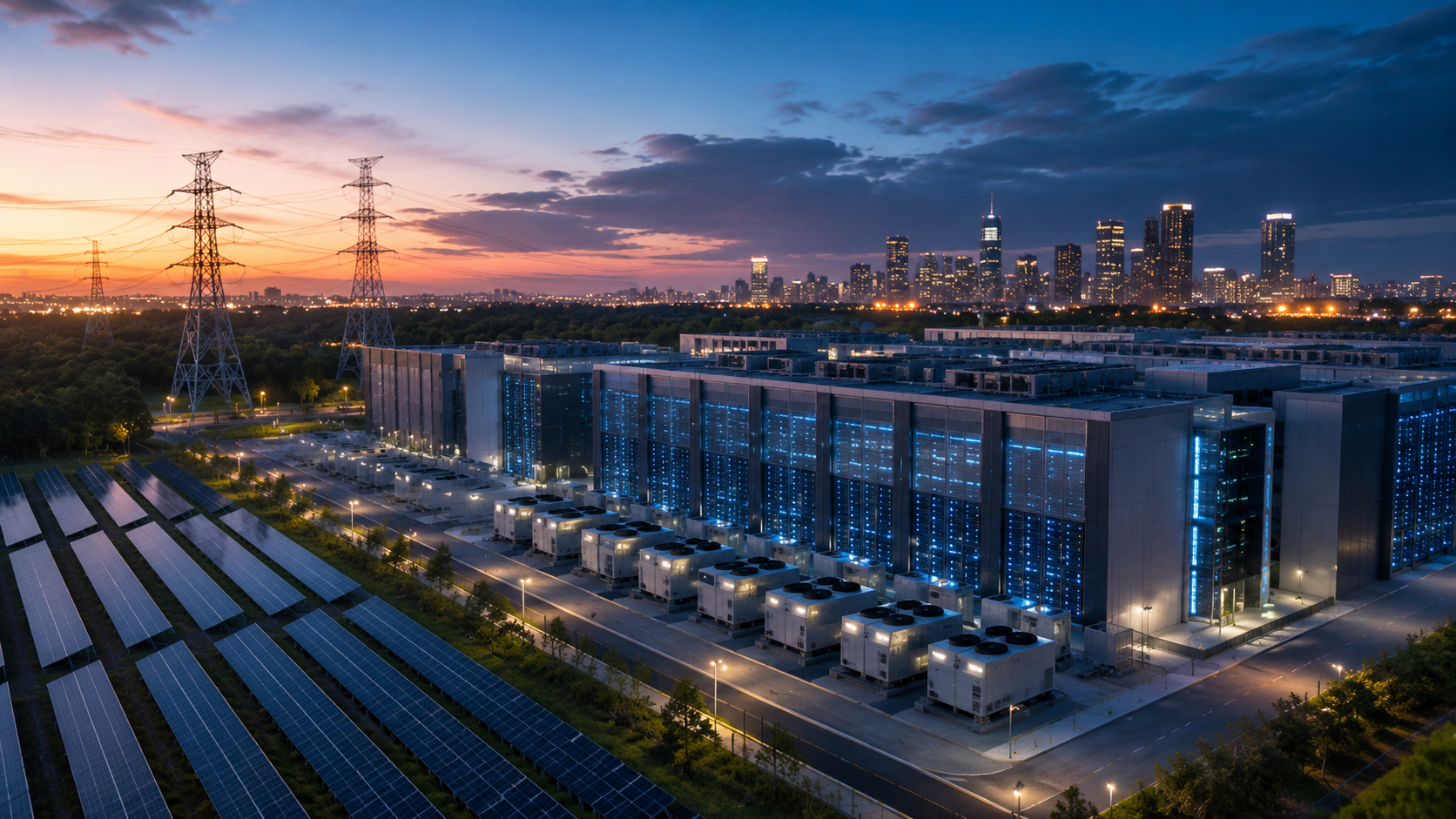
Why data centers are becoming one of the defining asset classes of the digital economy
For much of the digital era, the infrastructure that supported computing was treated as an operating expense of the technology industry rather than as an asset class in its own right. Servers were depreciating equipment, data centers were corporate real estate, and the economics of the cloud were assumed to favor scale within a small number of dominant operators. Capital markets paid attention to the platforms and applications running on top of this infrastructure, while the infrastructure itself sat mostly outside the conversation, treated as a technical detail of the businesses that needed it.
That assumption has not survived the rise of artificial intelligence. Over the past several years, the workloads required to train and operate large machine learning models have driven a build-out of physical infrastructure on a scale rarely seen outside of national energy or transport programs. Hyperscalers and specialist operators are committing capital in tens and hundreds of billions of dollars, while industry projections for AI-related infrastructure investment over the coming years now reach into the trillions. The infrastructure behind artificial intelligence has become a defining asset class of the digital economy, and the financing required to build it is reshaping institutional credit and equity allocation in ways that warrant closer attention than they typically receive.
Artificial intelligence runs on a physical substrate that is growing faster than the underlying economy it supports. Training a large model requires tens of thousands of specialized processors operating in concert, drawing on power, cooling, and network infrastructure of a kind that did not exist at this scale a decade ago. Inference, particularly for latency-sensitive applications, requires a more distributed geography of compute closer to end users. The economics of artificial intelligence have become an economics of buildings, transformers, fiber, and cooling systems as much as of code.
The Physical Economy of Artificial Intelligence
The capital implications follow from the physics. Combined infrastructure spending by the largest hyperscalers is projected to be measured in the hundreds of billions of dollars annually, with multi-year commitments stretching into the trillions for the largest consortia. A single new AI campus may carry a construction budget of several billion dollars, draw the power of a small city, and require a multi-year permitting and grid-interconnection process before its first server is racked. The intensity exceeds that of most other current technology businesses by an order of magnitude.
The most consequential development of the past three years has been the rise of electricity and grid access alongside capital and chips as binding constraints. Capital markets have expanded rapidly to finance the build-out, and accelerator supply has increased substantially, but for many new projects the limiting factor is increasingly the availability of grid-connected power. The queue for new grid interconnections in several established markets, including parts of the United States, Ireland, the Netherlands, and Singapore, now stretches several years, in some cases longer than the construction timeline of the facilities themselves.
The response has reorganized both how power is sourced and where capacity is built. Long-term power purchase agreements with utility-scale renewables, behind-the-meter generation, and direct agreements with nuclear producers have moved from the margins of energy procurement to standard practice. Investment in small modular reactors, geothermal, and other forms of dispatchable generation is being underwritten in part by the requirements of this single sector. New construction is increasingly looking beyond legacy clusters such as northern Virginia and Frankfurt toward markets selected for power availability, regulatory posture, fiber access, and long-term infrastructure capacity, including Texas, the Nordics, parts of the Middle East, and selected Latin American markets, while inference workloads continue to require distributed presence closer to end users.
A New Asset Class Takes Shape
The combination of long-duration cash flows, creditworthy tenants, scarce inputs, and capital intensity at scale has produced an asset class that increasingly resembles infrastructure more than real estate. Conventional commercial real estate is leased on five-to-ten-year cycles, exposed to tenant credit of varying quality, and traded on relatively liquid markets. A hyperscale data center is leased on fifteen-to-twenty-year cycles, anchored by a small group of investment-grade counterparties, and priced as much for its access to power and connectivity as for its location. The result is a risk profile, a return horizon, and a financing structure that look distinct from those of the real estate sector with which the asset class is still sometimes grouped.
Institutional capital has recognized the distinction. Over the past several years, the largest infrastructure investors, alternative asset managers, sovereign wealth funds, and pension systems have built or acquired significant data center platforms, and private capital allocated to the sector has grown from a specialist niche to one of the most active categories of infrastructure investment. A separation is emerging within institutional allocation between the technology businesses that run on top of artificial intelligence infrastructure, exposed to rapid product cycles and competitive disruption, and the infrastructure itself, which is settling into the patterns of institutional credit and infrastructure equity. Capital is increasingly being assembled to participate in the second category without the volatility of the first.
The Capital Stack Behind the Build-Out
The financing structures supporting the build-out have evolved rapidly, and they reveal the institutional character of the sector more clearly than its public reputation suggests. Hyperscaler-funded construction remains the largest single category, with major operators committing their own balance sheets at unprecedented scale. Sale-leaseback arrangements move significant volumes of completed assets from operator balance sheets into long-term institutional ownership. Project finance structures modeled on those used for utility-scale energy projects fund new builds with debt syndicated to insurance companies, pension funds, and infrastructure credit funds, while securitizations backed by data center cash flows have become an increasingly relevant financing source.
For cross-border institutional banking, the resulting transactions create patterns that are unfamiliar in some respects and recognizable in others. The deals routinely involve multi-jurisdictional structures, with assets in one country, financing entities in another, and tenants in a third. They require coordination between treasury, custody, structured credit, and trade finance functions, often across multiple regulatory regimes. The long-duration nature of the underlying receivables, combined with the credit quality of the counterparties, makes the flows attractive to a wide range of institutional investors, while the complexity of the structures and the policy sensitivity of several of the underlying inputs make the work of structuring and supporting them a distinct discipline.
The cumulative effect of these arrangements is what most directly affects the architecture of institutional capital allocation. A new category of long-duration, investment-grade-anchored, infrastructure-style asset has appeared at large scale within a single decade. Allocations to fixed income, real estate, and infrastructure are being reweighted around it, and underwriting, custody, and treasury frameworks are being adapted to handle its specific structural features. The composition of institutional portfolios is shifting in ways that reflect, among other things, the growth of artificial intelligence in the underlying real economy.
The Risks That Remain
The structural appeal of the asset class is real, but several categories of risk deserve closer attention than they have received during the period of rapid expansion. Technological obsolescence is one. The accelerator hardware on which the underlying workloads depend has been evolving at unusual speed, and the optimal configuration of a data center has shifted within a single product generation. A facility designed around one cooling regime, one power density, and one network topology may be partially obsolete several years before the end of its lease, and the mitigations that exist require continued capital investment and operational flexibility of a kind that not all institutional structures readily support.
Tenant concentration is another. The investment-grade quality of the largest hyperscalers is a defining feature of the asset class, but it also means that demand for new capacity is dominated by a small number of counterparties whose strategic priorities can change rapidly. A reassessment of capacity needs by one or two of these tenants would propagate through leasing pipelines in ways that more diversified real estate sectors would not experience. Power price volatility, regulatory exposure, and increasing community resistance to large facilities add further dimensions of risk that traditional infrastructure underwriting does not always capture in full.
The geopolitical dimension is also material. The build-out of artificial intelligence infrastructure is influenced by export controls on advanced accelerators, by the policy posture of host jurisdictions toward foreign operators, and by the bilateral relationships that determine where new capacity can be built and to which customers it can be sold. Risk frameworks that treat these factors as marginal will tend to underweight the importance of jurisdictional selection in long-duration data center investment. The institutions most capable of evaluating the asset class accurately are those that incorporate these dimensions alongside the more conventional measures of credit and cash flow.
The Permanence of the Physical
Much of the early discussion of artificial intelligence emphasized its abstraction. The technology has been described in terms of intelligence, language, reasoning, and creativity, in ways that suggest a category of activity primarily made of software. The build-out of the past several years has clarified the matter. Artificial intelligence is, at its foundation, a physical industry that depends on land, electricity, cooling systems, copper, steel, and the long-duration capital required to assemble these inputs into operational facilities. The physicality has been there from the beginning, and it has only become visible as the scale has grown.
For institutional capital, the implication is straightforward and substantial. The infrastructure behind artificial intelligence is becoming one of the defining asset classes of the digital economy, and the financing required to support it is reshaping institutional allocation, underwriting, and counterparty practice. The capital being deployed is long-duration, the tenants are creditworthy, and the constraints are physical and policy-driven rather than purely commercial. The institutions most effective at participating in this build-out are those that recognize its character early and that build the analytical and operational frameworks to engage with it on its own terms.
The most consequential shift may be the simplest to describe. Technology has rejoined the world of physical infrastructure, and the financing of that infrastructure has rejoined the central work of institutional finance. The two had been separated by a generation of assumptions about scale, software, and intangibility, and they are converging again. The institutions most aware of the convergence are likely to define how this asset class develops in the coming decade.
About Berkeley Financial
Berkeley Financial is an international financial group providing institutional banking, private banking, custody, and cross-border financial solutions. With a focus on governance, relationship-driven execution, and multi-jurisdiction expertise, Berkeley supports institutions and sophisticated clients with international financial needs across key markets, including Latin America, Europe, and the United States.
Back to Home
Disclaimer
This article is provided for informational purposes only and does not constitute investment, legal, tax, regulatory, or financial advice, nor an offer, solicitation, or recommendation to buy or sell any security, financial instrument, investment product, or infrastructure asset. References to sectors, financing structures, and market trends are general in nature and may change over time. Institutions should evaluate any investment, financing, or strategic decision based on their specific objectives, risk tolerance, jurisdiction, and applicable regulatory requirements.