Why strategic materials are moving from cyclical exposure to structural relevance
Commodities have long occupied a familiar place in financial analysis. They rise and fall with cycles of growth, inflation, monetary policy, and supply disruption. Their price movements are watched closely because they often reveal what more abstract indicators obscure: whether factories are operating, whether consumers are spending, whether supply chains are constrained, and whether geopolitical stress is reaching the real economy. For institutional investors, this has traditionally made commodities useful but episodic. They were tactical exposures, inflation hedges, or expressions of a macroeconomic view, rather than central components of long-term portfolio architecture.
That framework is becoming less complete. The global economy is moving through a period in which physical inputs are regaining strategic significance. Energy security has returned to the center of national policy. Industrial strategy has become more explicit across major economies. Supply-chain resilience is now evaluated not only by companies, but by governments, regulators, and long-horizon capital providers. Defense planning increasingly depends on materials whose production and processing are concentrated in a small number of jurisdictions. Artificial intelligence, often described as a software revolution, is driving demand for electricity, data centers, semiconductors, cooling systems, copper, and grid infrastructure. The result is a gradual but important reclassification of certain commodities from cyclical exposures into structural assets.
This does not mean commodities have ceased to be volatile. They remain subject to price swings, inventory cycles, weather, policy decisions, speculation, and shifts in demand. What has changed is the context in which that volatility is being evaluated. For a growing number of institutions, the relevant question is no longer only whether a commodity will rise or fall in the next cycle. It is whether the material itself has become part of the infrastructure of economic security, industrial competitiveness, and technological transformation.
Beyond the Commodity Cycle
The traditional commodity cycle is built around demand acceleration and supply response. When growth strengthens, consumption of energy, metals, and agricultural inputs rises. Prices increase, producers invest, supply expands, and eventually the cycle moderates. When growth slows, demand falls, inventories build, and prices decline. This pattern has not disappeared, and it remains essential to understanding short-term commodity behavior.
Yet the current environment contains forces that are not easily captured by this older cyclical model. Electrification, data center construction, grid modernization, defense rearmament, renewable-energy deployment, and strategic stockpiling all create demand that is tied less to ordinary business cycles than to multi-year policy and infrastructure programs. These programs are not driven only by current prices. They are driven by perceived vulnerabilities in the physical systems that support modern economies.
A copper mine, a uranium enrichment facility, a rare earth separation plant, a lithium refinery, or a high-voltage transmission corridor cannot be brought online quickly in response to a price signal. These assets require permitting, financing, engineering, environmental review, political support, and years of development. In some cases, the processing capacity is more important than the mineral itself. In others, the ability to move, store, refine, or secure the commodity becomes the real bottleneck.
This mismatch between strategic demand and slow supply response is one reason certain commodities are acquiring structural relevance. Their importance is not simply a function of scarcity. It is a function of how difficult they are to replace, how long they take to develop, and how central they are to the systems now being built.
The Return of Energy Security
Energy remains the foundation of the commodity complex, and its strategic importance has only increased. The energy transition has not reduced the need for secure energy systems; it has made the structure of those systems more complex. Economies must now finance legacy energy, renewable generation, storage, transmission, backup capacity, and new industrial loads at the same time. The growth of artificial intelligence and data centers has intensified this challenge by adding large, continuous electricity demand in regions where grids were not designed for such rapid load growth.
This creates a more complicated investment landscape than the simple substitution of old energy by new energy. Oil and natural gas continue to matter, particularly where dispatchable generation, transport, petrochemicals, and industrial heat remain difficult to replace at scale. At the same time, renewable energy requires enormous quantities of physical inputs: copper for wiring and transmission, rare earth elements for certain high-performance magnets, lithium and graphite for batteries, steel and concrete for infrastructure, and land and grid access for deployment.
Energy security, therefore, is no longer only about barrels, pipelines, or reserves. It is about the reliability of interconnected systems. A country may have renewable potential but insufficient transmission. A region may attract data center demand but lack firm power. A manufacturer may be committed to electrification but exposed to metal supply risks. In such an environment, energy strategy and commodity strategy become inseparable.
For institutions, this has a direct implication. Exposure to the energy system can no longer be evaluated only through the lens of commodity price beta. It must also be assessed through infrastructure, regulation, capital intensity, jurisdictional alignment, and the durability of demand created by national and corporate investment plans.
Strategic Materials and Industrial Policy
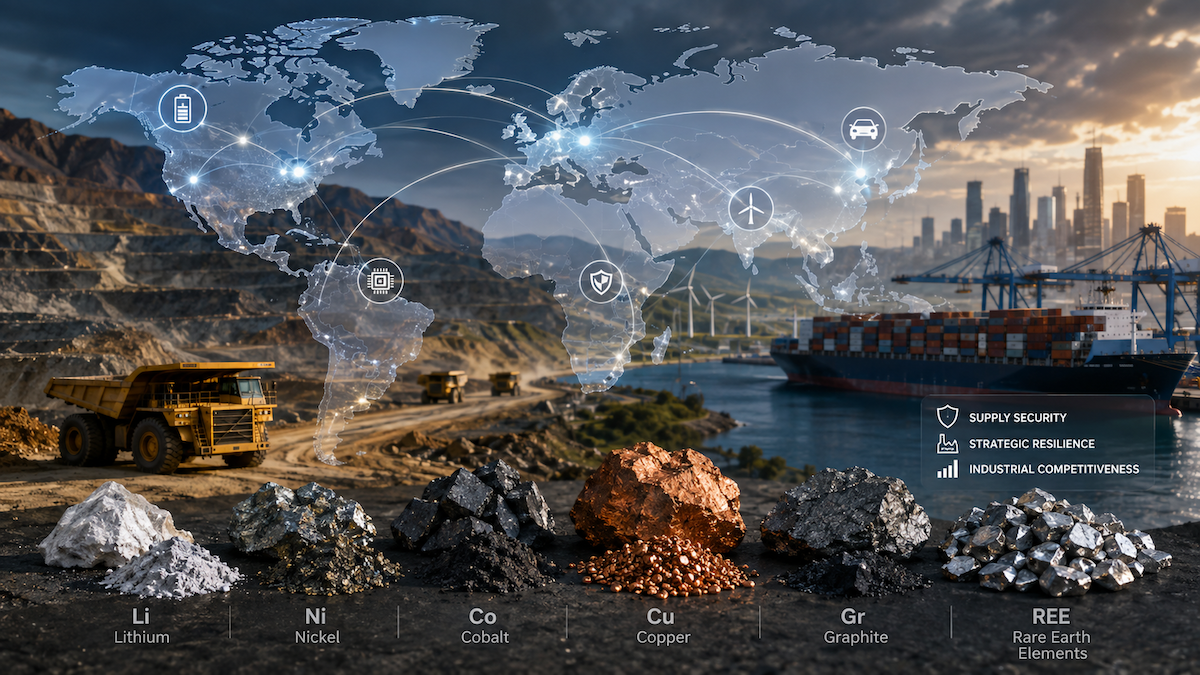
The renewed focus on strategic materials is one of the clearest signs that commodities are being reclassified. Copper, lithium, nickel, cobalt, graphite, uranium, rare earth elements, and other critical inputs now sit at the intersection of industrial policy, defense planning, energy security, and technological competition. Their importance is not measured solely by the size of their markets, but by the systems they enable.
Rare earth elements illustrate the point. The market is small compared with oil, iron ore, or copper, but the materials are critical to many advanced magnets, defense systems, electric motors, wind turbines, and precision technologies. The strategic bottleneck is often not mining, but processing and separation. A mineral may be mined in one country, refined in another, turned into a component in a third, and embedded in a defense or energy system in a fourth. Each stage carries commercial, regulatory, and geopolitical risk.
Copper presents a different but equally important case. It is not exotic. It is a foundational industrial metal. Yet its role in electrification, grids, renewable power, electric vehicles, and data center infrastructure makes it central to the physical economy now emerging. Demand for copper is being shaped by multiple structural programs at once, while new mine supply remains difficult to develop quickly.
Uranium has also returned to strategic relevance as nuclear power reenters the policy conversation in many jurisdictions. The issue is not only the price of uranium, but the security of fuel supply, enrichment capacity, reactor life extensions, and the role of nuclear generation in systems that require low-carbon dispatchable power. The commodity is only one part of a broader energy-security framework.
Across these examples, the pattern is similar. Materials that were once evaluated mainly as commodity exposures are increasingly being analyzed as strategic inputs into national and corporate balance sheets.
Supply Chains Become Capital Allocation Questions
The fragmentation of the global economy has changed how supply chains are understood. For decades, efficiency was the dominant logic. Production moved toward lower-cost locations, inventories were minimized, and supply networks were built around price, scale, and specialization. That model produced enormous gains, but it also created dependencies that were not fully appreciated until disruption exposed them.
Today, supply chains are being redesigned around resilience as well as efficiency. This does not mean globalization is ending. It means that the geography of production, processing, and logistics is being reassessed. Friend-shoring, nearshoring, export controls, strategic stockpiles, and long-term offtake agreements are all manifestations of the same underlying shift: access to physical inputs has become a matter of institutional planning.
For capital providers, this changes the nature of the opportunity. Financing a commodity-linked asset is no longer simply a question of price outlook and production cost. It requires analysis of jurisdictional stability, permitting regimes, infrastructure access, sovereign priorities, environmental constraints, counterparties, and the policy framework that may support or restrict development. The commodity is embedded in a system.
This is particularly relevant in cross-border finance. A processing facility may depend on feedstock from one region, technology from another, debt financing from a third, and customers in several more. Currency exposure, regulatory treatment, sanctions risk, export controls, and contractual enforceability all become part of the financial architecture. The institutions capable of supporting such projects must understand not only the commodity, but the corridor through which it moves.
The AI Infrastructure Connection
Artificial intelligence has added a powerful new dimension to the commodity discussion. Much of the public debate around AI focuses on models, software, and productivity. Yet the build-out required to support AI is intensely physical. It requires data centers, electricity, cooling, land, fiber, semiconductors, transformers, substations, and grid upgrades. Each of those categories pulls on real assets and commodity supply chains.
Data centers require steel, concrete, copper, electrical equipment, cooling systems, backup power, and reliable grid access. Semiconductors require specialized materials, high-purity inputs, rare gases, advanced manufacturing equipment, and highly complex supply chains. Power demand from AI workloads is pushing utilities, hyperscalers, and governments to consider new generation, transmission, nuclear power, renewables, storage, and behind-the-meter solutions.
This makes AI part of the commodity story, even if it rarely appears that way in market narratives. The technology may be digital at the user interface, but its growth depends on physical capacity. For institutional investors, this creates a bridge between two areas that are often analyzed separately: technology and real assets. The companies that build models may capture one layer of value, but the infrastructure and materials that allow those models to operate may capture another.
The significance is not that every AI-related commodity will rise uniformly. Markets will remain uneven. Some materials will face substitution. Some supply chains will expand faster than expected. Some projects will fail. The point is more structural: the demand created by AI is bringing commodities, power systems, and infrastructure into the center of a technology-driven capital cycle.
Portfolio Relevance and Institutional Discipline
As commodities become more structurally relevant, their role in portfolios requires greater precision. The case for exposure is not the same across all materials, nor is the method of exposure. Direct commodities, commodity-linked equities, infrastructure assets, private credit, royalty structures, offtake agreements, project finance, and structured products each carry different risks and return characteristics.
This distinction matters. A listed mining equity is not the same as exposure to the underlying metal. A regulated transmission asset is not the same as a merchant power project. A long-term offtake agreement is not the same as spot-price exposure. A structured note linked to a commodity index is not the same as an ownership interest in physical infrastructure. Each provides access to a different part of the value chain.
For institutions, the question is not whether commodities are attractive in the abstract. It is where, how, and why exposure should be held. Some exposures may serve as inflation hedges. Others may provide participation in structural demand. Others may support liability matching, yield generation, supply security, or strategic alignment with long-term policy trends. The portfolio role must be defined before the instrument is selected.
Governance is essential. Commodities can be volatile, politically sensitive, and operationally complex. Real assets can be illiquid, capital-intensive, and exposed to permitting, environmental, and regulatory risk. A structural thesis does not remove cyclical risk. It changes the reason the exposure is evaluated, and it requires a framework capable of distinguishing between temporary price movement and durable economic relevance.
A New Geography of Strategic Inputs
The fragmentation of the global economy is producing a new geography of strategic inputs. Materials, processing facilities, ports, grids, pipelines, power plants, and logistics corridors are being revalued according to their role in resilience and competitiveness. This geography is not based only on resource endowment. It is based on the interaction between resources, infrastructure, policy, capital, and trusted counterparties.
Countries with abundant minerals may not capture the full value if they lack processing capacity. Countries with strong industrial demand may remain vulnerable if they depend on external supply. Countries with renewable resources may struggle without grids, storage, and financing. Regions that combine resources, infrastructure, political alignment, and capital access may become more important than their historical market weight suggests.
This is why commodities are increasingly relevant to institutions engaged in cross-border finance. The movement of strategic materials requires banking relationships, custody frameworks, trade finance, treasury management, currency coordination, and risk interpretation across jurisdictions. The financial system must support the physical system, and the physical system is becoming more central to financial outcomes.
Structural Relevance, Not Certainty
The reclassification of commodities from cyclical exposure to structural relevance should not be confused with a guarantee of returns. Structural demand does not prevent overinvestment. Policy support can change. Technology can alter material intensity. Substitution can reduce demand for specific inputs. Commodity markets have a long history of turning compelling long-term stories into painful short-term losses.
The institutional case is therefore not based on certainty. It is based on relevance. Certain commodities and real assets now sit closer to the center of the economic transformations shaping the next decade. Their prices will continue to fluctuate, but their strategic importance is less likely to disappear with the next turn of the business cycle.
This is the key distinction. A tactical allocation asks what a commodity may do in the next phase of inflation, growth, or monetary policy. A structural allocation asks whether the commodity has become part of the operating system of the economy being built.
The Architecture of Global Economic Strategy
Commodities are returning to institutional attention because the physical economy is returning to the center of financial outcomes. Energy security, AI infrastructure, electrification, industrial policy, defense needs, and supply-chain resilience are all making specific materials and real assets more important than they were in the previous investment cycle.
For institutions, this requires a broader analytical frame. Commodities should not be viewed only as a price series or a hedge. They should be evaluated as strategic inputs, as infrastructure-linked assets, as components of cross-border supply systems, and as exposures shaped by policy, geography, and capital availability.
The global economy is becoming less abstract. The materials, energy systems, and infrastructure that support it are becoming more visible. In that environment, commodities are no longer only tactical instruments in a cyclical allocation. Increasingly, they are part of the architecture of global economic strategy.
About Berkeley Financial
Berkeley Financial is an international financial group providing institutional banking, private banking, custody, and cross-border financial solutions. With a focus on governance, relationship-driven execution, and multi-jurisdiction expertise, Berkeley supports institutions and sophisticated clients with international financial needs across key markets, including Latin America, Europe, and the United States.
Disclaimer
This article is provided for informational purposes only and does not constitute investment, legal, tax, regulatory, or financial advice, nor an offer, solicitation, or recommendation to buy or sell any commodity, security, financial instrument, investment product, or real asset. References to sectors, asset classes, and market trends are general in nature and may change over time. Institutions should evaluate any investment, financing, or strategic decision based on their specific objectives, risk tolerance, jurisdiction, and applicable regulatory requirements.