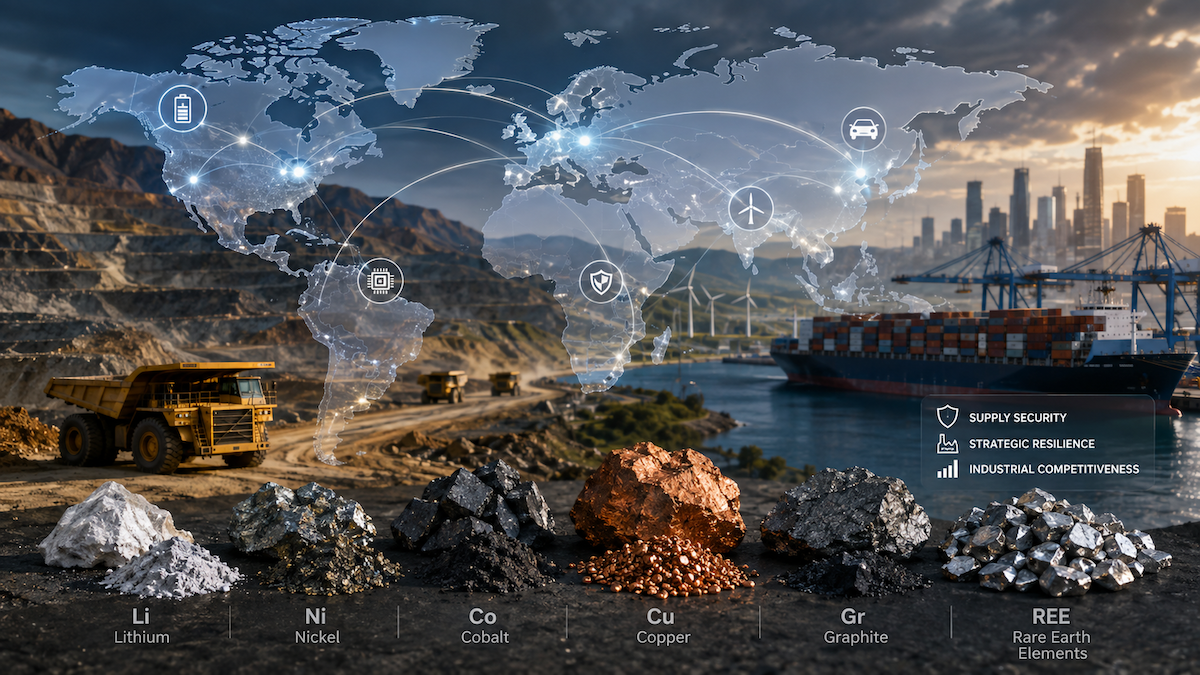
Why access to strategic materials is becoming a financial, industrial, and geopolitical question
Critical minerals have moved from the technical language of geologists and procurement departments into the center of economic strategy. For most of the post-Cold-War period, the materials beneath modern industry were treated as background inputs. Copper connected power systems, lithium and nickel sat within battery chemistries, cobalt and graphite supported energy storage, and rare earth elements entered magnets, motors, electronics, and defense systems. These materials mattered, but their supply chains were assumed to function with the quiet efficiency of globalization itself.
That assumption is weakening. The same global economy that once optimized strategic materials around cost and specialization is now reconsidering them through the lens of resilience, security, and jurisdictional control. The shift is not limited to a single mineral, country, or sector. It extends across lithium, nickel, cobalt, graphite, copper, rare earths, and a wider group of strategic inputs whose importance has been amplified by electrification, artificial intelligence infrastructure, defense procurement, advanced manufacturing, and the reorganization of supply chains.
The result is a broader change in how critical minerals are evaluated by institutions. They are no longer simply inputs into production or commodities exposed to price cycles. Increasingly, they are treated as financial, industrial, and geopolitical variables whose availability can influence capital allocation, trade relationships, infrastructure planning, and national strategy.
From Commodity Input to Strategic Constraint
The traditional commodity framework begins with price. If demand rises, prices increase. If prices increase, supply responds. Eventually, markets rebalance. This framework remains useful, but it is poorly suited to materials whose supply chains require years of development, complex processing, environmental approvals, and political alignment across jurisdictions.
Critical minerals expose the limits of price as a coordinating mechanism. A higher copper price may encourage exploration and mine expansion, but it cannot quickly create new deposits, permitting capacity, smelting infrastructure, or transmission networks. A surge in demand for lithium may bring investment, but refining capacity, battery-grade qualification, and downstream offtake contracts remain separate bottlenecks. A shortage of graphite or rare earth magnets cannot be solved only by identifying more mineral resources if the processing and component manufacturing remain concentrated elsewhere.
This is why the current discussion has moved from availability to access. Mineral resources may exist in several countries, but usable supply depends on extraction, processing, refining, logistics, financing, environmental compliance, and reliable trade channels. The strategic question is no longer only where the mineral is located. It is whether the entire chain can deliver the material at the quality, timing, scale, and political reliability required by the industries that depend on it.
Demand Growth and the New Industrial Base
The demand story is increasingly structural. The International Energy Agency reported that demand for key energy minerals continued to grow strongly in 2025, driven by batteries, electric vehicles, energy storage, grids, wind turbines, solar power, and high-performance permanent magnets. According to the IEA, demand for these key minerals has grown at close to 10% per year on average in recent years, with lithium demand increasing around 25% annually over the past two years and the energy sector accounting for roughly 75% of demand growth in 2025.
These figures point to a deeper transformation. Electrification increases demand for copper, battery metals, graphite, and grid materials. Artificial intelligence infrastructure adds pressure through data centers, power systems, cooling equipment, transformers, semiconductors, and transmission networks. Defense modernization depends on advanced materials, high-performance magnets, specialty alloys, sensors, and electronic components. Each sector reinforces demand for overlapping categories of minerals, creating a multi-sector pull that is less cyclical than previous commodity booms.
This does not mean demand will rise smoothly. Technology can reduce material intensity, substitution can change chemistry, and supply expansions can create periods of oversupply. Battery metals have already shown that strong structural demand can coexist with price weakness when supply grows faster than expected. The institutional point is more precise: the relevance of critical minerals is no longer measured only by spot price performance. It is measured by their role in the industrial systems now being financed.
Processing as the Strategic Chokepoint
The most important feature of many critical-mineral supply chains is not geological scarcity, but processing concentration. Mining attracts attention because it is visible, politically contested, and capital-intensive. Yet for several critical minerals, the decisive bottleneck lies further downstream, in refining, separation, chemical conversion, and component manufacturing.
The IEA’s outlook highlights the degree of concentration. Even where mining becomes more diversified, refining operations for most minerals are expected to remain highly concentrated. In its base case for 2035, China is projected to supply more than 60% of refined lithium and cobalt, and around 80% of battery-grade graphite and magnet rare earth elements. The agency also notes that for graphite and rare earths, supply concentration remains a key vulnerability even where global balances may appear adequate.
This distinction changes the geography of risk. A country may possess mineral resources without controlling the processing capacity that turns them into industrial inputs. A company may secure a mining offtake agreement but remain dependent on refining in another jurisdiction. A government may subsidize downstream manufacturing while leaving upstream or midstream bottlenecks unresolved. Supply security depends on the chain, not the mine alone.
For institutions, processing concentration creates a new layer of analysis. Financing a project requires understanding not only geology and cost curves, but the credibility of processing partners, the jurisdiction of refining assets, the durability of export permissions, and the ability to qualify output for end users. The economics of the mineral and the politics of the supply chain have become inseparable.
Copper, Lithium, and the Time Problem
Copper and lithium illustrate the problem of timing. Copper is essential to electrification, grids, industrial infrastructure, renewable power, electric vehicles, and data centers. Lithium is central to many battery technologies and to the electrification of transport and storage systems. Both are supported by strong long-term demand narratives, yet both face constraints that cannot be resolved quickly.
The IEA has identified copper and lithium as major exceptions in projected supply-demand balances under today’s policy settings, with expected mined supply from announced projects falling short of projected 2035 demand by roughly 30% for copper and 40% for lithium. For copper, declining ore grades, higher project costs, and slower resource discoveries make new supply particularly difficult to bring online. For lithium, near-term balances may look more comfortable, but demand growth later in the decade could again create tighter conditions.
The issue is not only quantity. It is timing, quality, and location. A copper project can take more than a decade to move from discovery to production. Lithium supply may expand more rapidly, but battery-grade conversion, permitting, environmental constraints, and downstream qualification remain demanding. The capital cycle in these materials moves at a different speed from the policy and technology cycles driving demand.
This mismatch is one reason institutional capital is paying closer attention. When demand is structural and supply response is slow, the financing of mines, refineries, processing facilities, infrastructure corridors, and offtake arrangements becomes a strategic function. Capital is not merely following the commodity cycle. It is being asked to build the physical capacity that the next industrial cycle requires.
Export Controls and the Repricing of Jurisdiction
The politics of supply is most visible in export controls. Restrictions on strategic materials are no longer exceptional instruments reserved for wartime conditions. They have become part of the normal vocabulary of economic security. China has imposed or tightened controls on several strategic minerals and related technologies, including gallium, germanium, graphite products, antimony, rare earth magnet technology, and, more recently, rare earth elements and magnets subject to licensing regimes. Reuters has described these measures as part of a widening set of export restrictions tied to national interest and security concerns.
These controls have a broader significance than the immediate effect on any one shipment. They show that supply chains once treated as commercial infrastructure can become instruments of policy. A mineral, processing technology, or component may remain physically available, but access to it can be conditioned by licenses, end-use rules, bilateral relationships, or diplomatic context. For industries that depend on predictable input supply, this changes the meaning of resilience.
Jurisdiction therefore becomes a pricing variable. Assets located in politically aligned jurisdictions may command strategic value even if their cost structure is less competitive. Processing facilities in trusted jurisdictions may attract public support or long-term offtake agreements. Projects that reduce dependency on a single supplier may be financed under terms that reflect policy value as well as commercial return. Trade corridors are being reorganized around reliability, not only efficiency.
Policy Incentives and the Rebuilding of Supply Chains
Governments have responded by building critical-mineral strategies that resemble industrial policy more than conventional resource policy. The European Union’s Critical Raw Materials Act sets 2030 benchmarks across extraction, processing, recycling, and supply diversification, including targets of at least 10% of annual consumption from EU extraction, 40% from EU processing, 25% from recycling, and no more than 65% of annual consumption of any strategic raw material from a single third country at any relevant stage of processing.
Similar priorities are visible elsewhere through subsidies, loan guarantees, strategic partnerships, tax incentives, defense procurement, stockpiling, and expedited permitting. The details vary by jurisdiction, but the direction is consistent: governments are trying to reduce dependence on concentrated supply chains while building domestic or aligned capacity in materials considered essential to strategic technologies.
This policy support changes the investment landscape. It can improve project economics, reduce financing risk, and create demand visibility through public procurement or offtake agreements. It can also introduce political dependency, regulatory complexity, and the risk that incentives change with governments or fiscal conditions. Institutional investors must therefore evaluate not only the project, but the policy framework supporting it.
The result is a more complex form of underwriting. A critical-minerals project may depend on commodity prices, permitting timelines, energy costs, environmental standards, processing technology, public subsidies, offtake counterparties, and geopolitical alignment. A purely market-based analysis is no longer sufficient. Neither is a purely policy-based one. The value lies in understanding the interaction between the two.
Financing the Supply Chain
The financing of critical-mineral supply chains increasingly involves structures that extend beyond traditional mining finance. Upstream extraction remains important, but capital is also needed for midstream processing, refining, chemical conversion, recycling, logistics, ports, storage, and downstream manufacturing. Many of these assets sit between commodity markets and industrial infrastructure, which makes their financing more complex.
A lithium refinery, for example, is not simply a commodity asset. It is a processing facility tied to feedstock agreements, energy costs, environmental requirements, battery-quality specifications, and end-user contracts. A graphite anode supply chain may depend on mine supply, spherical graphite processing, coating technology, transport, and automotive qualification. A copper expansion may require power infrastructure, water access, community agreements, smelting capacity, and long lead times.
These projects require patient capital and sophisticated risk allocation. Offtake agreements can provide revenue visibility, but they introduce counterparty concentration. Government support can reduce financing risk, but it may come with domestic-content requirements or policy conditions. Cross-border capital can accelerate development, but it must navigate currency exposure, foreign investment screening, sanctions risk, environmental standards, and legal enforceability.
For banks and institutional capital providers, critical minerals therefore create a set of opportunities that are highly relevant but operationally demanding. The financial institution does not merely provide capital to a commodity project. It helps structure a corridor between resource, processing capacity, end-user demand, policy support, and long-term capital.
Institutional Investment and the Question of Exposure
For institutional investors, the rise of critical minerals raises a difficult question: how should exposure be held? Direct ownership of mining or processing assets offers participation in physical supply, but it requires technical expertise, long time horizons, and tolerance for operational risk. Listed equities provide liquidity, but they also introduce company-specific risks and equity-market correlation. Private credit can offer structured exposure to cash flows, but it depends heavily on covenant design, collateral quality, and counterparty discipline. Commodity-linked instruments can express a price view, but they may not capture the economics of processing, logistics, or policy support.
This distinction is central. Critical minerals are not a single asset class. They are a set of interlocking value chains. The investment case for copper differs from the case for lithium, nickel, cobalt, graphite, or rare earths. Even within a single mineral, the economics of mining, processing, refining, recycling, logistics, and end-use contracts can differ sharply.
A disciplined institutional approach therefore begins with the purpose of the exposure. Is the objective inflation sensitivity, participation in electrification, supply-chain resilience, yield from infrastructure-like cash flows, strategic access to offtake, or diversification away from purely financial assets? The answer determines the appropriate instrument. Without that clarity, the critical-minerals theme can easily become a broad narrative attached to an unsuitable exposure.
The Risks of Strategic Enthusiasm
The strategic case for critical minerals is strong, but it should not be mistaken for investment certainty. The history of commodities is filled with compelling demand stories that led to overinvestment, price collapses, stranded assets, and disappointing returns. The presence of a structural theme does not eliminate cyclical risk. It often attracts capital, and capital can create excess supply.
Technology can also alter demand. Battery chemistries change. Material intensity can decline. Recycling can improve. Substitution can reduce dependence on one input while increasing dependence on another. A mineral considered critical in one technology configuration may become less central if the technology evolves. Policy can support a project, but policy can also shift. Environmental, social, and permitting risks can delay or impair even strategically important assets.
Concentration risk cuts both ways. Dependence on a single supplier creates vulnerability for consumers, but dependence on a single customer or subsidy program creates vulnerability for producers. Projects financed on the assumption of permanent policy support or guaranteed scarcity may disappoint if markets adjust faster than expected.
This is why governance matters. Critical-minerals exposure requires careful attention to valuation, contract structure, counterparty risk, jurisdiction, liquidity, and time horizon. Strategic relevance is a reason for analysis, not a substitute for it.
A Financial, Industrial, and Geopolitical Question
Critical minerals now occupy a position where finance, industry, and geopolitics intersect. Their supply chains determine the feasibility of energy transition targets, the resilience of defense manufacturing, the speed of AI infrastructure deployment, and the competitiveness of advanced industrial economies. Their financing requires long-duration capital, technical expertise, policy alignment, and cross-border coordination. Their risks extend beyond price into jurisdiction, access, processing capacity, and trade controls.
This is the politics of supply. It is not politics in the narrow sense of partisan debate. It is the recognition that access to strategic materials is shaped by decisions made by governments, corporations, investors, and counterparties across multiple jurisdictions. The same ton of material can carry different value depending on where it is mined, where it is processed, who controls the technology, who buys it, and whether the trade corridor remains open.
For institutions, the practical implication is clear. Critical minerals cannot be analyzed only as commodities, nor only as industrial inputs, nor only as geopolitical instruments. They must be understood as strategic assets embedded in physical systems and financial structures. Their importance lies not simply in their price, but in their role within the architecture of the economy being built.
The global economy is becoming more demanding of the materials that support it. The institutions capable of understanding that demand, financing the required capacity, and navigating the politics of supply will be better positioned to operate in the industrial geography now taking shape.
About Berkeley Financial
Berkeley Financial is an international financial group providing institutional banking, private banking, custody, and cross-border financial solutions. With a focus on governance, relationship-driven execution, and multi-jurisdiction expertise, Berkeley supports institutions and sophisticated clients with international financial needs across key markets, including Latin America, Europe, and the United States.
Disclaimer
This article is provided for informational purposes only and does not constitute investment, legal, tax, regulatory, or financial advice, nor an offer, solicitation, or recommendation to buy or sell any commodity, security, financial instrument, investment product, or real asset. References to commodities, sectors, countries, policies, supply chains, and market trends are general in nature and may change over time. Critical minerals and related investments may involve risks, including market risk, liquidity risk, operational risk, environmental risk, regulatory risk, geopolitical risk, counterparty risk, and the risk of loss. Institutions and clients should evaluate any investment, financing, or strategic decision based on their specific objectives, risk tolerance, jurisdiction, and applicable regulatory requirements.