In an era of geopolitical friction and regulatory divergence, the quiet machinery that sustains global commerce is undergoing a profound recalibration.
Trade finance rarely commands headlines. It operates in the background of global commerce — a system of letters of credit, guarantees, structured payment mechanisms, and institutional relationships that allow goods to move across oceans and borders with a degree of certainty that modern economies have come to take for granted. Yet beneath its procedural calm, trade finance is changing.
The past decade has seen the architecture of international trade shift in ways that are both structural and subtle. Supply chains have been reconfigured, geopolitical alignments recalibrated, and regulatory regimes increasingly differentiated. What once functioned as a relatively integrated ecosystem is now evolving into a more fragmented landscape — one in which institutions must navigate not only commercial risk but jurisdictional nuance and political complexity. Trade continues to flow. But the conditions under which it is financed have grown markedly more intricate.
When Geopolitics Interrupts Commerce
Recent events in the Middle East provide a vivid illustration of how quickly the assumptions underlying global trade can be disrupted.
The current confrontation involving the United States, Israel, and Iran has sent shockwaves through energy markets and shipping routes. For a period, tanker traffic through the Strait of Hormuz — the narrow maritime corridor through which roughly one fifth of the world’s oil supply normally passes — slowed dramatically as insurers, ship operators, and traders reassessed risk exposure.
Markets responded with the speed characteristic of modern commodity trading. Oil prices surged sharply amid fears that the conflict could interrupt Middle Eastern supply, at one point pushing crude toward levels not seen since the aftermath of the pandemic-era recovery.
Even temporary disruptions reverberate widely. Higher energy prices ripple through shipping costs, fertilizer markets, manufacturing inputs, and ultimately consumer inflation. Analysts warn that sustained disruption to Gulf exports could reshape trade patterns and strain global economic growth.
For trade finance institutions, such events underscore an enduring truth: commerce does not move through a frictionless global marketplace. It moves through corridors defined by geography, politics, and infrastructure. When any one of those elements shifts, the financial structures supporting trade must adapt quickly.
The End of Seamless Globalization
For much of the late twentieth and early twenty-first centuries, trade finance operated within an expanding framework of globalization. Banks developed extensive correspondent networks. Documentation standards converged. Multilateral institutions supported harmonization across jurisdictions.
This period fostered a sense of procedural continuity. Transactions could be structured within a predictable framework of rules, counterparties, and settlement expectations. That framework has not collapsed, but it has become more uneven.
Trade corridors that once appeared stable are now subject to political recalibration. Regulatory oversight varies increasingly from one jurisdiction to another. Financial institutions must reconcile not only commercial documentation but supervisory expectations that may diverge significantly between regions.
The result is not a reduction in trade activity. It is a multiplication of the variables that underpin each transaction. Where trade finance once relied primarily on standardized instruments, it now depends more heavily on interpretive capacity.
Supply Chains and Strategic Geography
At the same time, the geography of trade itself is evolving. Supply chains that once stretched seamlessly across continents are being reconsidered in light of resilience and proximity. Nearshoring initiatives in the Americas, energy realignment across global markets, and strategic diversification of production hubs are reshaping how goods move between regions.
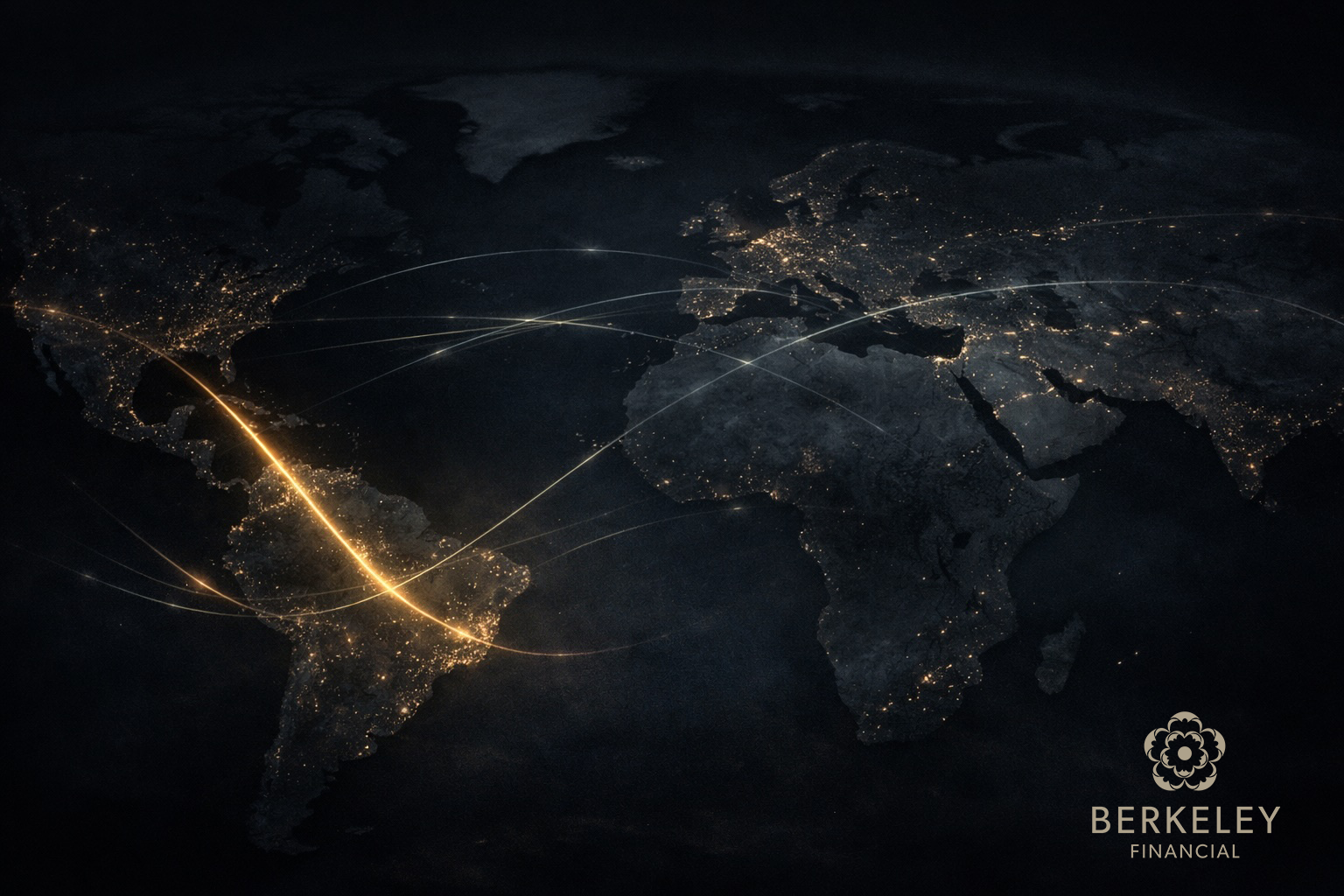
These shifts have particular significance for financial institutions operating between Latin America and the United States. Trade flows across this corridor are not merely cyclical responses to commodity prices or currency movements. They are increasingly structural, driven by industrial policy, demographic dynamics, and capital investment patterns. In such an environment, trade finance becomes more than a transactional service. It becomes a form of infrastructural support for evolving economic relationships.
Documentation Meets Judgment
Trade finance has always relied on documentation — bills of lading, inspection certificates, letters of credit that translate commercial agreements into enforceable financial commitments. Yet documentation alone cannot resolve every challenge in today’s fragmented environment.
Transactions increasingly require contextual interpretation: understanding regulatory expectations across jurisdictions, assessing political and currency exposure, evaluating counterparty credibility beyond standardized metrics.
These dimensions cannot be reduced entirely to automated processes or algorithmic scoring models. They require judgment. And judgment, in institutional finance, is inseparable from relationship continuity.
Trade Finance as Strategic Infrastructure
Seen from a distance, trade finance appears procedural — a technical layer beneath the movement of goods. In reality, it functions more like infrastructure. Without reliable financing mechanisms, supply chains stall. Liquidity becomes trapped within jurisdictions. Commercial confidence erodes.
As global trade adapts to new geopolitical and economic realities, the institutions capable of sustaining this infrastructure quietly assume greater importance. They serve not only as providers of capital but as intermediaries of trust — reconciling documentation, governance, and jurisdictional expectations in transactions that may span multiple continents. This role is not easily replicated by scale alone. It depends on expertise, operational discipline, and enduring institutional relationships.
Navigating the Fragmented Landscape
Fragmentation in global trade does not necessarily signal instability. In many respects, it reflects the natural evolution of an international system adjusting to new economic and political realities. But fragmentation does demand adaptation.
Institutions participating in cross-border commerce must cultivate banking relationships capable of navigating complexity without introducing additional friction. They must consider not only the availability of financing but the institutional capacity behind it — the ability to structure transactions with clarity, interpret regulatory nuance, and maintain continuity across jurisdictions.
Trade finance will likely remain one of the quieter corners of global finance. Its work will continue to unfold in documentation rooms rather than on trading floors. Yet its significance is growing.
In a world where commerce increasingly traverses a fragmented landscape, the institutions that enable goods to move with confidence may prove to be among the most important actors in the global economy — even if they remain largely out of view.
About Berkeley Financial
Berkeley Financial is an international financial group providing institutional banking, private banking, custody, and cross-border financial solutions. With a focus on governance, relationship-driven execution, and multi-jurisdiction expertise, Berkeley supports institutions and sophisticated clients operating across Latin America and the United States.